Koatoval Kingdom
The Deer KingThe Ancient Kingdom of Otawalle was a prosperous realm whose collapse under epidemic disease reshaped Aquafa’s political origins and left a lasting inheritance of medical learning. Its survivors relinquished independent rule but preserved their knowledge and influence, making the kingdom’s fall both a historical rupture and the beginning of another kind of continuity.
Realm and Achievements
For thousands of years, the Ancient Kingdom of Otawalle encompassed the salt mine, the Yukata Plains in the south, the Oki District in the north, and the Toga Mountains in the west. Its people excelled in medicine, engineering, and the arts, and their odes remembered lives of affluence. Yet the very breadth of this realm could not protect its political structure when a strange disease killed many of its able statesmen and then spread into a full epidemic. The crisis, about two and a half centuries before the events described, precipitated the kingdom’s rapid decline.
The cause of the catastrophe was not understood. Some people claimed that Otawalle knowledge had exceeded human limits and encroached on the realm of the gods, provoking divine wrath; the historical truth, however, had become obscure. This uncertainty left the kingdom’s destruction open to competing interpretations: a disaster whose medical cause remained unknown could also be remembered as punishment, curse, or warning.
Epidemic and Exodus
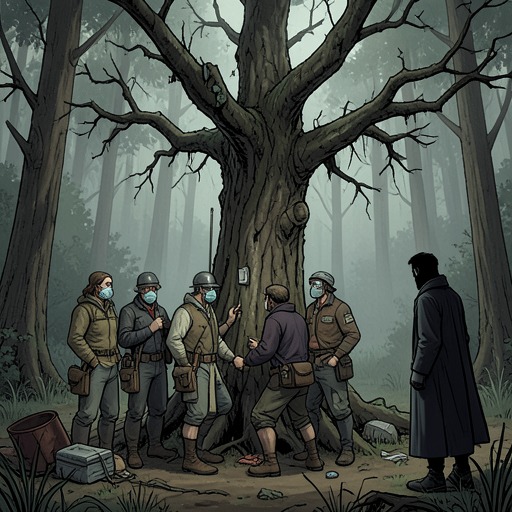
In the account Hohsalle gives of Otawalle’s fall, the epidemic is linked to black wolves brought from the Toga Mountains. The animals’ dark, unusual pelts and clever faces made them fashionable among noblemen, who competed to acquire them; merchants and hunters began capturing and selling the wolves, and some were reportedly bred with dogs. After merchants bitten by the animals developed a severe illness, the Divine King prohibited the trade. The disease seemed to disappear, then returned in summer and killed many people who had never been bitten. The account presents this sequence as the beginning of a calamity that escaped any simple explanation based on direct bites.
The kingdom’s geography shaped both the scale of the danger and the means of escape. Its main cities stood on three islands in a large inland sea. The enclosed setting was thought to have helped make the plague unusually lethal, but it also allowed the infected area to be sealed off. As the epidemic overwhelmed the capital, the last king, Takaluhalu, abandoned the city and destroyed the long bridge connecting it to the mainland. He left the sick and those who would not depart behind, sacrificing them in order to save people who had not been infected.
Ancient records described the evacuation as a stark, painful spectacle: pale-skinned Otawalle crossed the bridge in single file, having removed their clothes and shaved their body hair, while those left in the capital faced a cruel end. Hohsalle’s account refuses to let the event’s strange appearance soften its human cost. Takaluhalu’s departure was at once an act of containment and an abandonment of his people; he may have judged himself unfit to rule after turning away from them.
The Birth of Aquafa
Takaluhalu moved the capital to Kazan, a trading city in Aquafa that the epidemic had spared. There he transferred his authority to Kazan’s young Aquafaese ruler, who pledged to grant local autonomy to the realm’s diverse peoples. This political transfer established the Kingdom of Aquafa. Its founding was therefore bound not to a military victory but to the evacuation and political dissolution of Otawalle: Aquafa inherited authority through an agreement made amid flight from the epidemic.
The new kingdom did not erase the Otawalle community. Survivors established the Sacred Territory of Otawalle in a valley ringed by rugged mountains, where they continued to develop knowledge and skills in medicine and other fields. The Academy of Deeper Learning became the focal point of that inheritance. Even children of lower birth could study there, preparing for work suited to their abilities; once grown, many students left the sanctuary to settle in other regions, because the Otawalle chose not to maintain a country of their own.
Their approach was expressed in the academy’s motto, “Live By Helping Other Nations Live.” Otawalle knowledge and craftsmanship travelled with its graduates, became highly sought after abroad, and contributed to Aquafa’s prosperity. The former kingdom’s continuity thus rested less on restored territory than on knowledge carried into other societies and put to work there.
Influence After the Kingdom
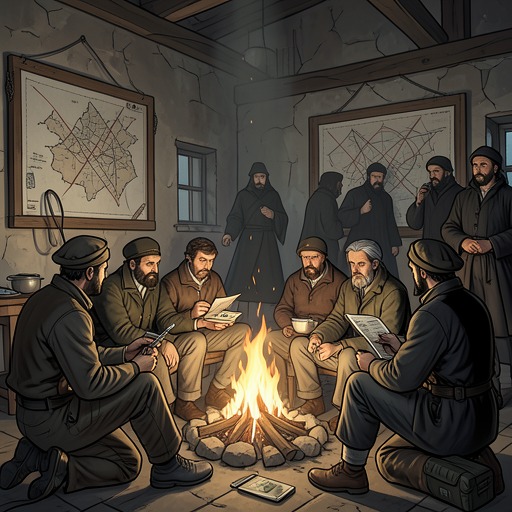
The Otawalle also retained political reach after relinquishing direct government. They had founded the Inner Circle, an information-gathering network extending across the kingdom, and continued to supply successive Aquafa rulers with intelligence. In the book’s image, if Aquafa were a human body, the Sacred Territory was its head: no longer the seat of a sovereign state, it remained a center of knowledge and counsel. When the current King of Aquafa capitulated to the Zolian Empire after only a few skirmishes, many suspected that the Otawalle had warned him of Zol’s overwhelming military power and persuaded him that negotiation was preferable to war.
That strategic accommodation echoed, without simply repeating, the founding transfer made by Takaluhalu. In both episodes, Otawalle influence was associated with preserving a community by yielding political ground before a stronger force. But the kingdom’s remembered flight also carries an unresolved moral cost: survival was secured by abandoning people who could not be saved, and later generations inherited both the knowledge preserved through that choice and the grief attached to it.
A Legacy of Survival and Medicine
The Otawalle’s survival after the kingdom’s destruction was described by Milalle as a form of incorporation rather than victory. She explained that the people did not think in terms of winners and losers: if they were to be consumed by another power, they would seek to be consumed well, because those who were eaten became part of the body that ate them. Makokan understood the image as a description of a people whose own political body had been destroyed but who endured by being absorbed into another kingdom. To him, this way of life demanded both resolve and considerable talent; Milalle’s further reflection that helping others live could enable the Otawalle to live sounded almost like a prayer.
Their medical inheritance remained consequential beyond Aquafa. Otawalle physicians’ success in treating the Zolian emperor’s wife had made their medicine attractive to nobles, even though it remained officially branded heresy under the Pure Heart Creed. In Hohsalle’s account of black wolf fever, reports of past survival also inform a proposed response to present infection: people in remote parts of Aquafa, Oki, and Toga were said to have survived without symptoms, and he recommends immediate injection with a solution containing a weakened disease agent. The Ancient Kingdom no longer existed as a political realm, but its history, medical knowledge, and example of survival through adaptation continued to shape decisions across the countries that followed it.